




Forms of Love -Legendary Shunga Scroll Chigo Sōshi on Display
Love, desire, the deep longing felt for another person—throughout history, people have wanted to see emotions expressed.
In Japan, at least since the Heian period (794–1185 CE), shunga-genre paintings have shown intimate scenes between men and women or between people of the same sex.
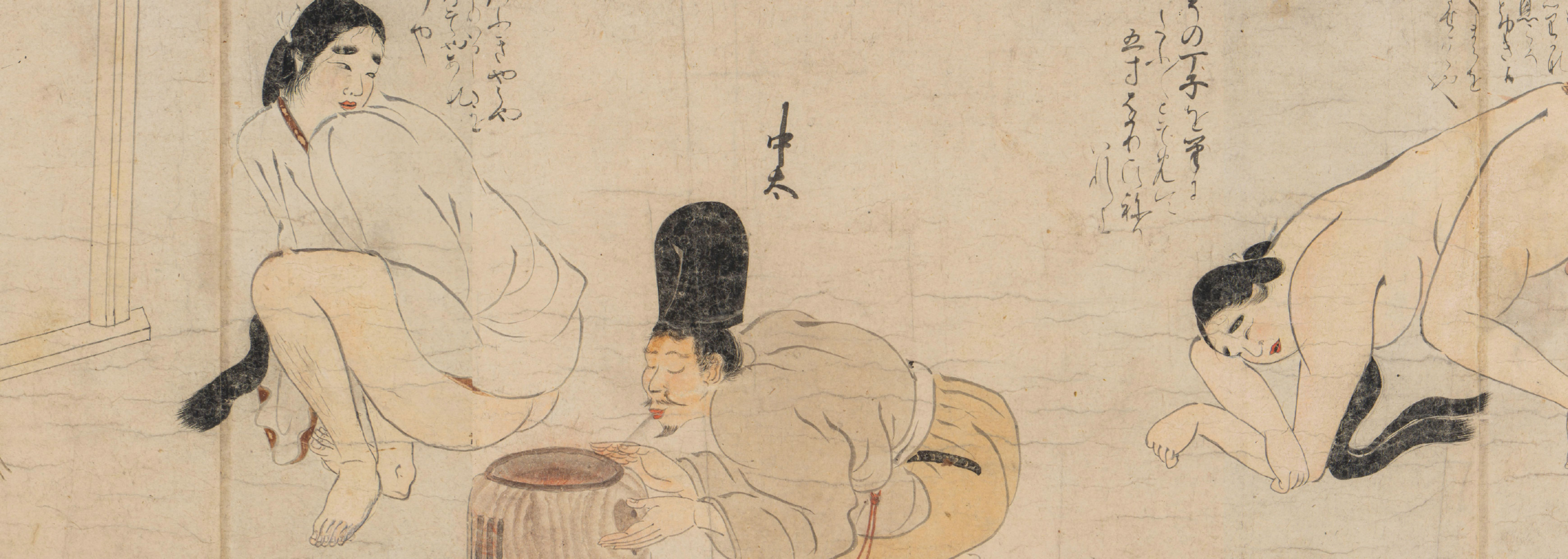
The highlight of this current exhibition is the original Chigo Sōshi, an illustrated scroll held to be the oldest surviving shunga in Japan. Created in the early 14th century, it combines text and pictures to depict the intimate relationship between a monk and a chigo (a young boy serving at a temple). Its existence was long known through copies and books, however, very few people had ever seen this phantom masterpiece.
Another exhibition highlight is a copy by Tani Bunchō (1763-1840) of the Koshibagaki Zōshi scroll. Depicting intimate acts between men and women, the original is one of Japan’s oldest known shungaworks. As well as Katsushika Hokusai’s masterpiece Nami Chidori, original paintings by artists such as Tsukioka Settei, and other erotic art, you can see works inspired by enduring love by such artists as Uemura Shōen and Kaburaki Kiyokata.
*Notice: Photography is prohibited for most artworks in this exhibition. Please be aware that NO photography is allowed on the 2nd Floor.
Section 1: Depictions of Love
Burning desire, the anguish of lovers torn apart, the bond between parent and child—stories of attachment have always offered artists an endless variety of human love to explore.
This section features works inspired by tales of love, spanning from The Tale of Genji—born in the Heian period—to Joruri puppet theater and Ukiyo-zōshi literature. Enjoy a profound exploration of deep-seated passion portrayed through the paintbrushes of masters such as Uemura Shōen and Kaburaki Kiyokata, alongside the rare display of Folding Screen with Fan Paintings of The Tale of Genji from the Muromachi period, unveiled to the public for the first time in 27 years.
In parallel, the exhibition introduces bijin-ga (portraits of female beauties) depicting women of the Edo period’s pleasure quarters—a unique world where love and beauty intertwine. Beyond their gorgeous attire and gracefully dignified expressions lies a fleeting fragility and hidden passion, sparking the imagination of all who behold them.
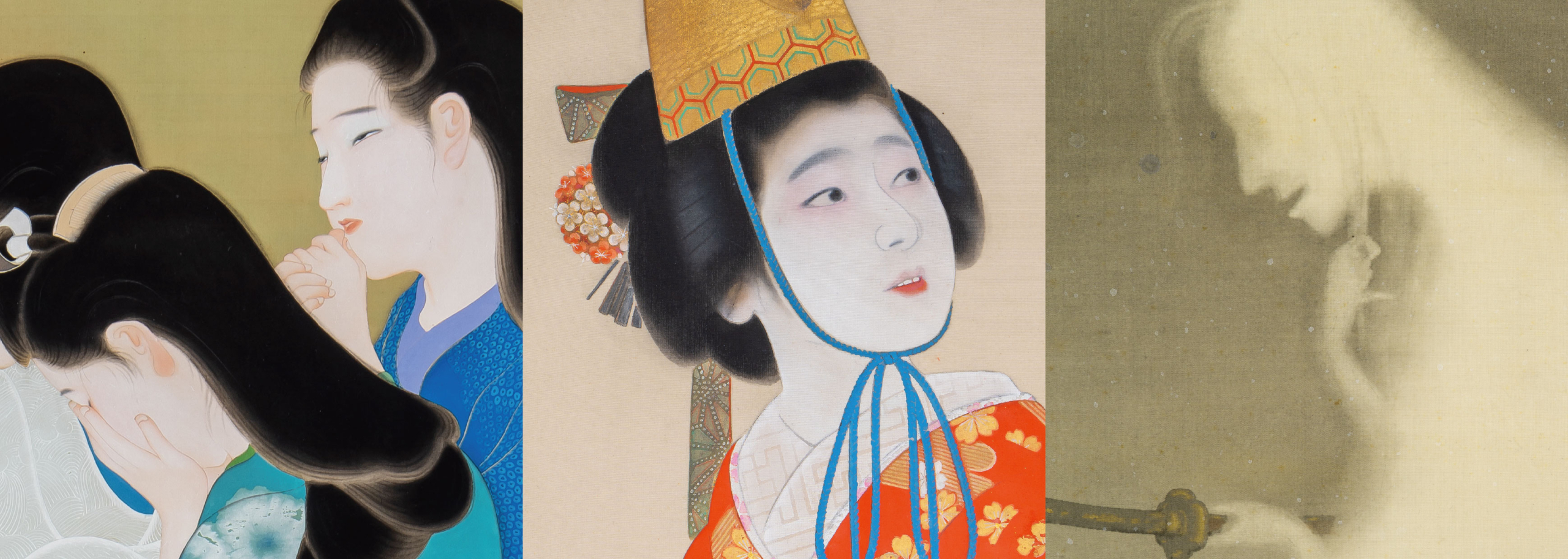
Section 2: Unveiled: The long-hidden Chigo Sōshi
Paintings depicting couples making love—shunga—probably existed as early as the Heian period (794–1185). Early examples took their cue from illustrations in medical texts imported from China. These guides to health and longevity described bōchūjutsu, techniques of sexual intercourse. They served largely as sex manuals or as diversions for aristocratic readers. In the Edo period (1603–1868), shunga reached a much wider audience: treating them as guides to sexual education, townspeople might include them as part of a bride’s trousseau.
Following modernization in the Meiji era (1868–1912), even while they were prized in Europe and the United States, the Japanese came to regard shunga as obscene. The shunga exhibition held at the British Museum, as recently as from 2013 to 2014, attracted much attention.
For the first time, we present to the public Chigo Sōshi, a shunga scroll newly added to the Fukuda Collection in 2025 (the scroll will be periodically unrolled to display different sections). Dating from the early fourteenth century, long kept by Daigo-ji temple, this phantom work has exceptional historical value.
You can also see outstanding shunga from the Edo through Meiji periods, including Koshibagaki Sōshi (Edo period, copy), which depicts a story tied to Nonomiya Shrine in Arashiyama, Kyoto.
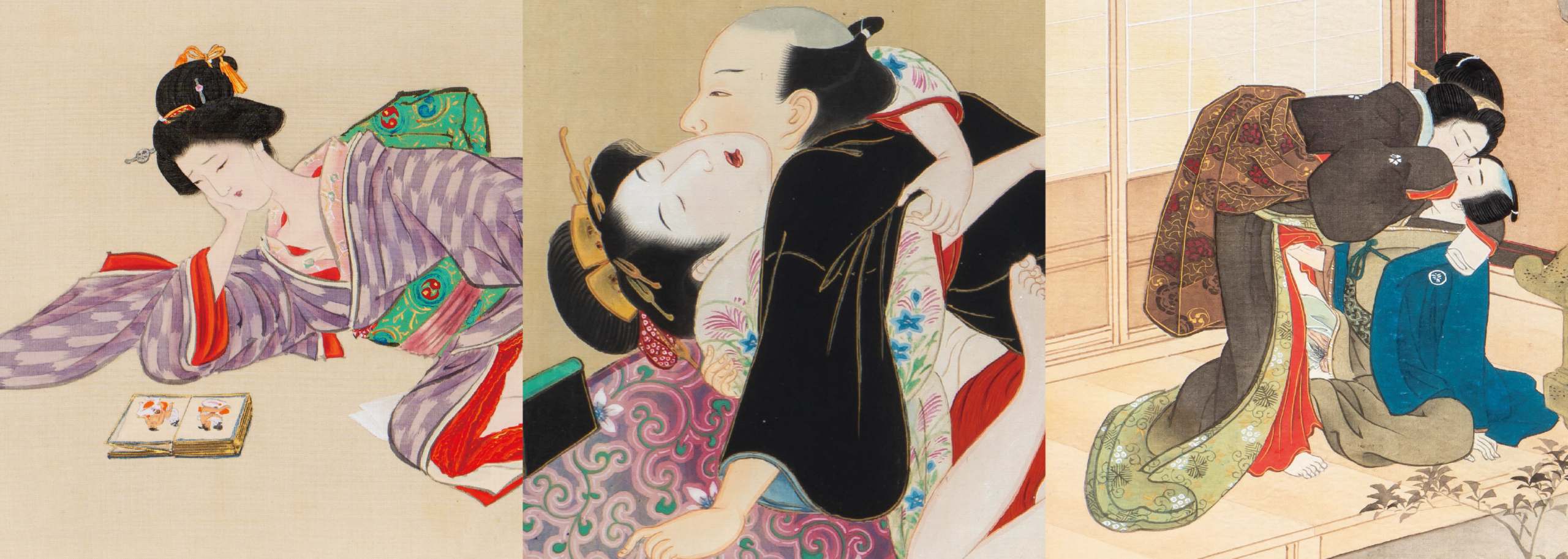
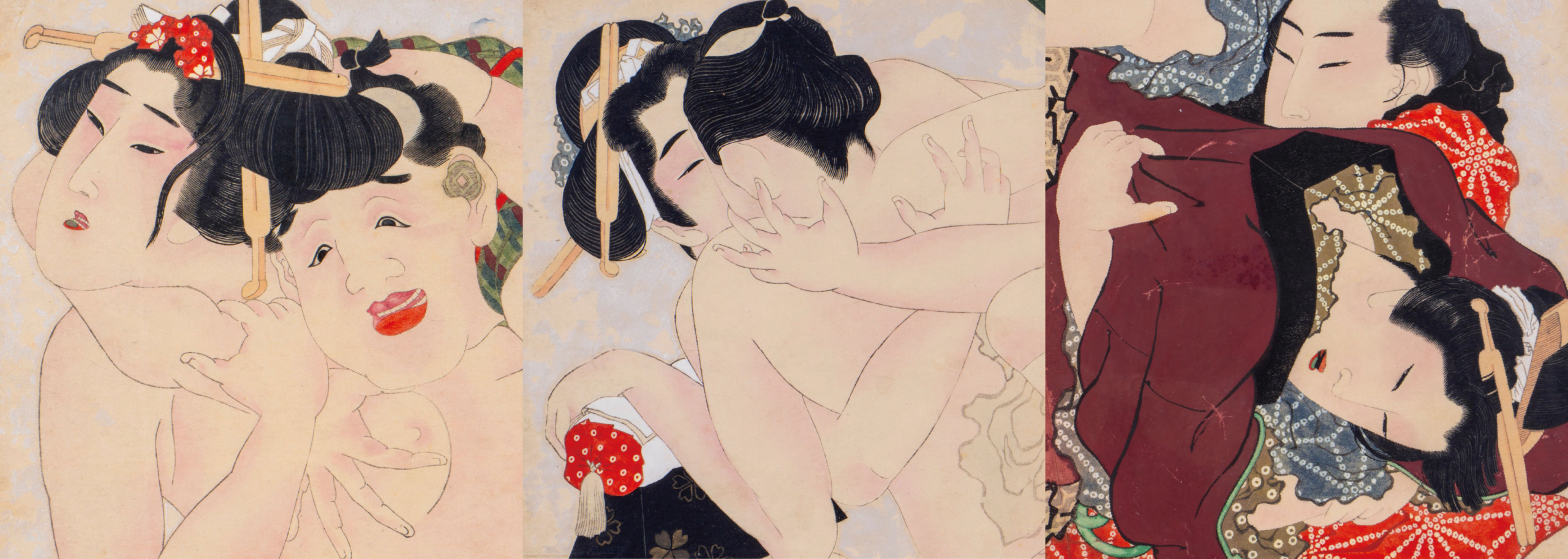
Section 3. Katsushika Hokusai, Nami Chidori (Plover in the Waves)
Katsushika Hokusai is probably the best-known Japanese artist in the world.
Nami Chidori, painted when Hokusai was in his seventies, is no mere masterpiece among his own shunga: many consider the set as the finest surviving Edo-period shunga. For prints, artisans hand-applied dense, saturated color to the omohan keyblock carrying the outline of Hokusai’s original drawing. They added further luster to the background using the kirazuri technique to dust the surface with powdered mica.
Most Edo-period shunga were filled with scene-setting detail: sliding shoji and fusuma screens, furnishings, sometimes cats, dogs, or other figures peering in on the couple. Hokusai stripped all of this from Nami Chidori. Without any setting or supporting actors, he filled the frame with nothing but two bodies. These he rendered boldly, larger than life. By eliminating everything extraneous, Hokusai sharply focused attention on the couple’s passion. See for yourself: even in his final years, Hokusai’s hand and eye retained their vigor.
*Admission is restricted to guests aged 18 and over.
*Unauthorized photography, recording, or any suspicious behavior within the exhibition galleries will result in immediate removal from the premises. In such cases, we may report or consult with the police and bar future entry to the museum. We kindly ask for your cooperation in maintaining proper etiquette while enjoying the exhibition.
Exhibition Overview
Supported by Kyoto Prefecture, Kyoto City, Kyoto City Board of Education
| Title |
Forms of Love -Legendary Shunga Scroll Chigo Soshi on Display |
||
|---|---|---|---|
| List of Works | |||
| Dates |
September 19 (Sat.) 2026 – January 17 (Sun.) 2027 |
||
| Opening Hours | 10:00 – 17:00 (last entry 16:30) | ||
| Closed |
Maintenance: October 20 (Tue.), December 15 (Tue.) |
||
| Venue |
Fukuda Art Museum: 3-16 Susukinobabachō Saga-Tenryuji, Ukyō-ku, Kyoto |
||
| Entry Fee |
General / University student: ¥1,500 (¥1,400) *Admission is restricted to guests aged 18 and over. You may be requested to present a government-issued photo ID upon entry.
<Combo Tickets with Saga Arashiyama Museum of Arts & Culture> *If you purchase an online ticket of the Fukuda Art Museum, you will get a discount for the entry fee of the Saga Arashiyama Museum of Arts & Culture. Therefore, you can enter both museums as the same price of the combo ticket. |
||