




Jakuchū: Prancing Feathers and Swelling Gourds
Since opening in October 2019, the Fukuda Art Museum has continued to collect engaging artworks created during the Edo period and up to the present day.
The Fukuda collection is especially pleased to have brought back to Japan Fruits and Vegetables, a long scroll by Itō Jakuchū (1716–1800). This noteworthy work, privately held in Europe for many years, was feared lost. When it came to light two years ago in 2023, we were able to add it to the collection.
After undergoing nearly one year of restoration by the museum, Fruits and Vegetables is ready to take its place alongside Saichufū, a similar Jakuchū scroll which shows insects as well as vegetables. It was painted one year later, in 1790, and has been designated an Important Cultural Property. Subject to rotation, we are presenting around 40 works by Jakuchū.
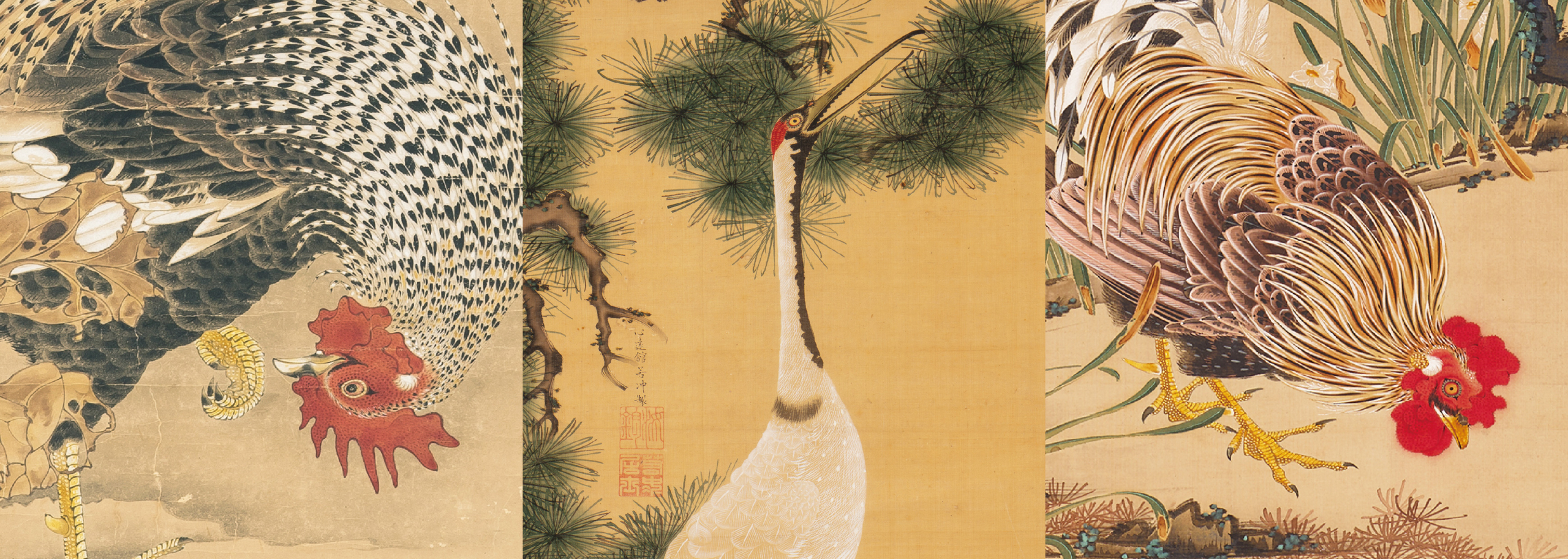
Section.1 Itō Jakuchū: Creative and Mind Driven by Insatiable Curiosity
This section begins with Rooster and Hen with Turnips, painted by Jakuchū in his thirties. It reveals the restless, luminous vitality so characteristic of his early works. Then, moving into his forties, are pictures such as Rooster among Flowers and Old Pine Tree and Crane, one of his few paintings on silk. These works were created before he completed his Colorful Realm of Living Beings series (National Treasure).
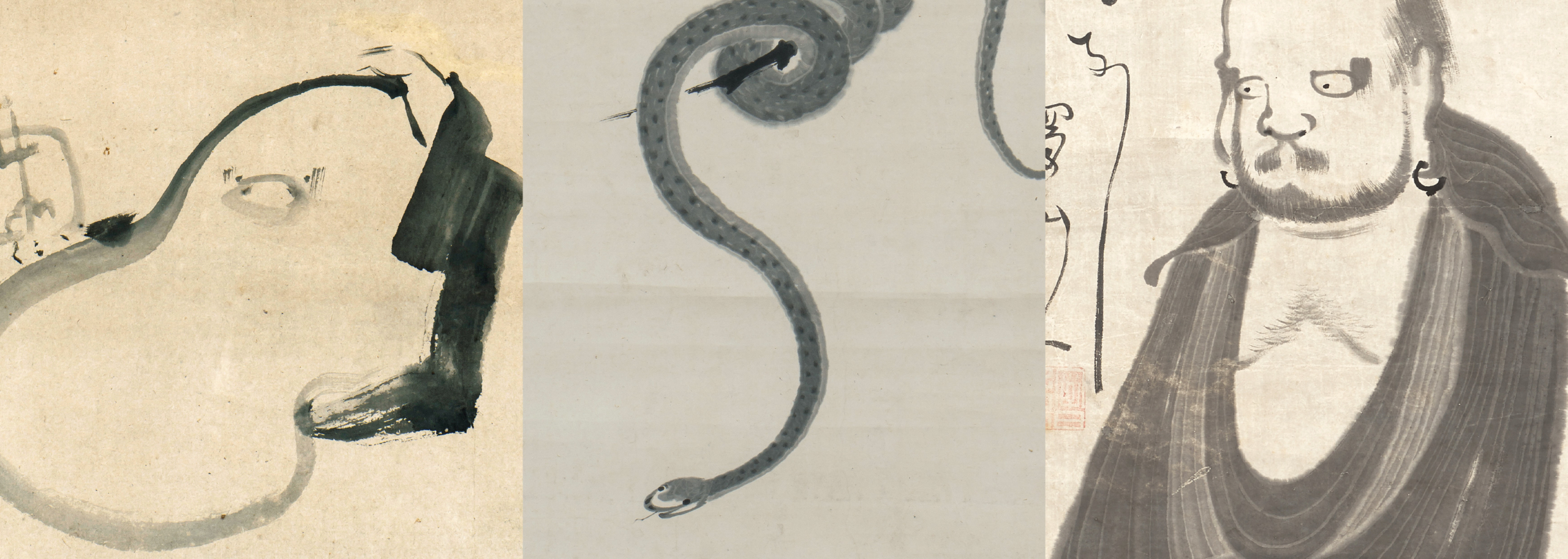
In Bodhidharma Crossing the Yangtze River on a Reed, you can marvel at the way Jakuchū commanded his sujime-gaki technique to control ink diffusion so as to leave thin, pale margins between brush strokes. Ever-driven by an inquiring mind, in this comprehensive exhibition your eyes can trace Jakuchū’s singular artistic trajectory, which effortlessly spanned two extremes: marvel at his meticulous polychrome brilliance and smile at the playful wit expressed in his fluid ink-wash painting.
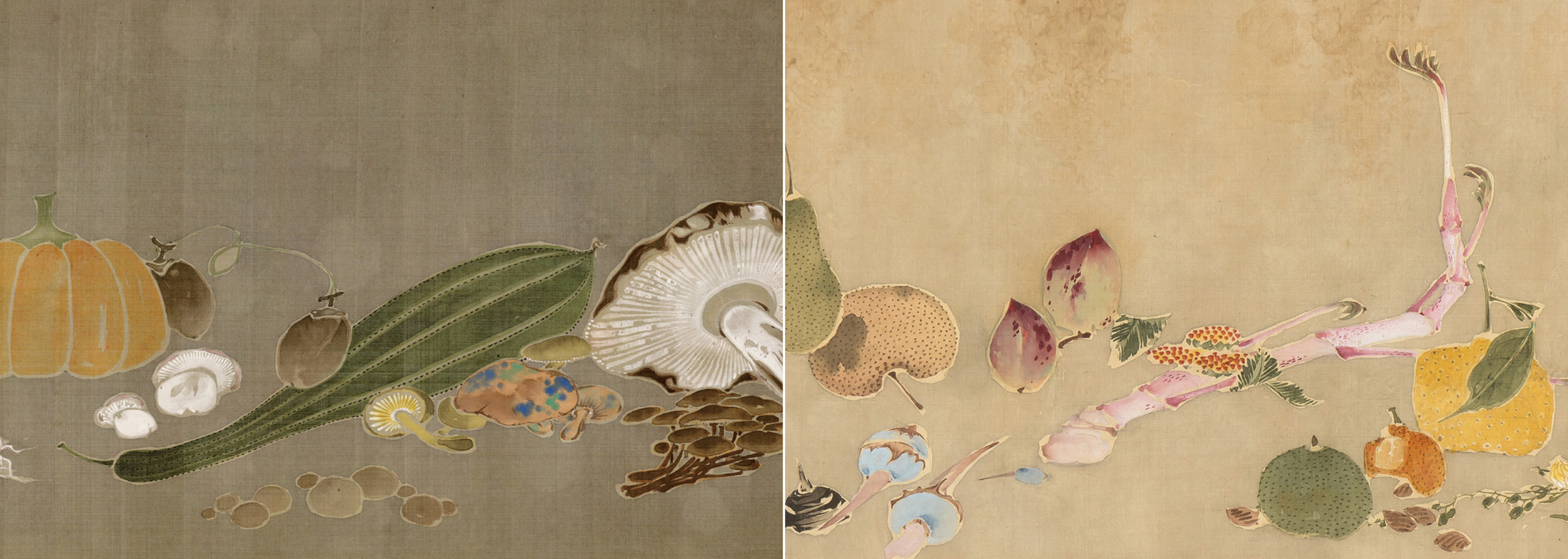
Section 2. Long scrolls: Fruits and Vegetables and Cmpedium of Vegetables and Insects
As the son of a vegetable wholesaler, Jakuchū was surrounded by vegetables until he left the business at age 40. His lifelong attraction to plant color and form, as well as his affection, is fully expressed in the roughly three-meter-long silk scroll Fruits and Vegetables. At the end of the scroll there is a colophon brushed by Baisō Kenjō (Daiten), Zen monk at Shōkoku-ji Temple, Jakuchū’s spiritual anchor and greatest supporter. A year after completing this scroll, Jakuchū painted another long scroll, the late-career masterpiece, Compendium of Vegetables and Insects (National Cultural Property).
In this section, Fruits and Vegetables, which recently underwent nearly a year of restoration, will be shown side by side with Compendium of Vegetables and Insects. In addition, for the first time, a very recently verified version of Vegetable Nirvana will also be on public display (shown from April 25 to May 8 / from June 20 to July 5) . In addition, for the first time, a very recently verified version of Vegetable Nirvana will also be on public display while Compendium of Vegetables and Insects are not displayed.
You can also see other works from Jakuchu’s later years. One is Happy Improvisations on a Riverboat Journey. It records a journey he made with Daiten down the Yodo River from Kyoto to Osaka. For this Jakuchū created pictures of riverside scenery using the distinctive taku-ban rub-printing technique. You can also appreciate this consummate artist’s mastery of bold, flowing brushwork that brilliantly shines from his folding-screen ink-wash depiction of The Thirty-Six Immortal Poets.
Section3. Jakuchū’s Contemporaries
In the 18th century, economic development and growing prosperity allowed art, formerly enjoyed only by samurai, court nobles, and wealthy merchants, to become widely appreciated by the general public. Growing demand was met both by the current generation of traditional artists and by others who, like Jakuchū, from merchant, farmer, and samurai families, aspired to paint.
This section shines a light on distinctive works from the Fukuda Collection by Jakuchū’s contemporaries, who also flourished in Kyoto. Soga Shōhaku (1730–1781) was born into a merchant family; Maruyama Ōkyo (1733–1795) was a farmer; and his disciple, Nagasawa Rosetsu (1754–1799) was born a samurai. Please enjoy their different ways of seeing the 18th century world in Japan.
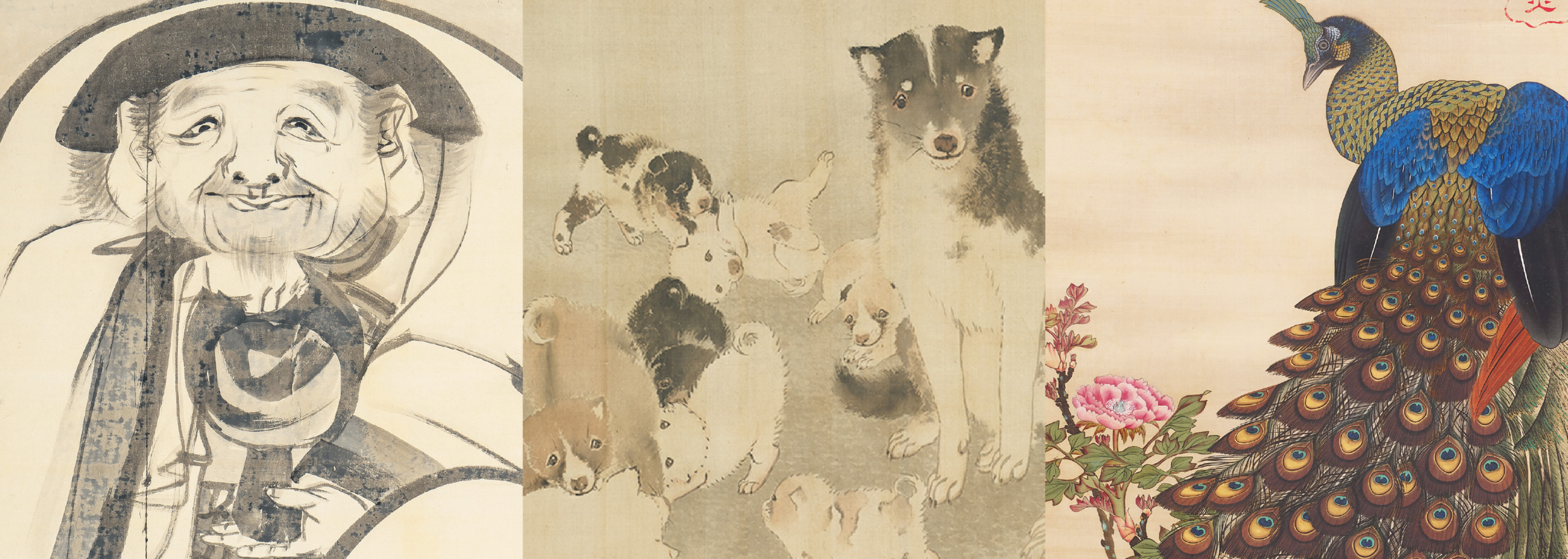
If you are not familiar with Jakuchū’s art, this is your chance to see the work of a major Japanese painter. You can trace how he developed as an artist and see what his contemporaries were doing. If you already admire Jakuchū, how could you not be interested?
Exhibition Overview
| Title |
Jakuchū: Prancing Feathers and Swelling Gourds |
|---|---|
| List of Works | |
| Dates |
April 25 (Sat.) 2026 – July 5 (Sun.) 2026 *Important Cultural Property Saichufū will be exhibited in the following period |
| Opening Hours | 10:00 – 17:00 (last entry 16:30) |
| Closed |
May 12 (Tue.) for facility inspection |
| Venue |
Fukuda Art Museum: 3-16 Susukinobabachō Saga-Tenryuji, Ukyō-ku, Kyoto |
| Entry Fee |
General / University student: ¥1,500 (¥1,400) * Prices in parentheses are for groups of 20 or more. *As this exhibition is supposed to be crowded, we recommend you to purchase an online ticket of the Fukuda Art Museum official site in advance with a discounted price. Online ticket sales close at 11:59 PM the day prior to admission. <Combo Tickets with Saga Arashiyama Museum of Arts & Culture> *Only sold at the reception of both museums *If you purchase an online ticket of the Fukuda Art Museum official site, you will get a discount for the entry fee of the Saga Arashiyama Museum of Arts & Culture. Therefore, you can enter both museums as the same price of the combo ticket. You can also purchase “Premium Morning Ticket” online starting from 9:15am in limited numbers. |
| Supported by | Kyoto Prefecture, Kyoto City, Kyoto City Board of Education |