




Let All be Well – Prayers in Paint –
Fukuda Art Museum in Arashiyama Kyoto is presents a special exhibition on the theme of “Prayer,” held from July 18 to September 6, 2026.
Even before history—before writing—people poured earnest hopes and heartfelt prayers into paintings. By creating art, and while viewing it, they have wished for the happiness of themselves and their loved ones, or hoped for peace in their country and beyond. Here, we are showing works that bring to light the diverse forms of prayer that artists have worked into their paintings.
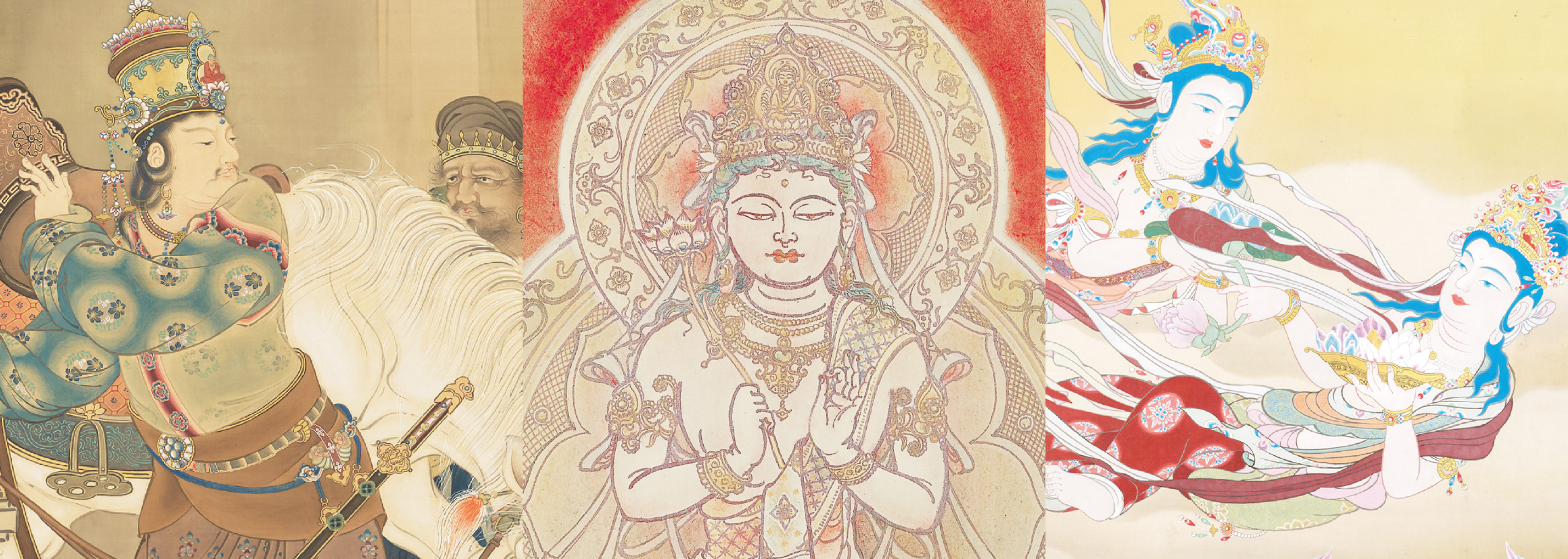
Section 1: The World of Buddhist Painting: Meet the Buddhas!
Initially as carved and sculpted images, Buddhist art came to Japan during the 6th century. Statues, such as the Great Buddha of Asuka-dera Temple (early 7th century), became objects of worship. Buddhist temples flourished alongside Shinto shrines.
Following the Meiji Restoration (1868), nationalist fervor stoked a strong anti-Buddhist movement. Temples were attacked and damaged: tens of thousands were completely destroyed. Buddhist art went through hard times. Eventually, thanks to the work of Okakura Tenshin (1863−1913) and others, this Japanese artistic tradition was salvaged and reinvigorated. Archaeological discoveries in India helped advocates to present Buddhism as a world religion to rival Christianity, and to position traditional Japanese Buddhist art as a repository of uncontaminated Buddhism. Meanwhile, exploring shadow and light and other Western realist techniques, painters discovered fresh possibilities for spiritual expression.
The first paintings in this gallery show episodes from the life of Shakyamuni Buddha by modern artists such as Yokoyama Taikan and Hishida Shunsō. These are followed by modern works depicting various manifestations of the Buddha by artists such as Irie Hakō and Murakami Kagaku, who channeled their deep spirituality into Buddhist imagery.
Section 2: The World of Auspicious Paintings: How is hope expressed?
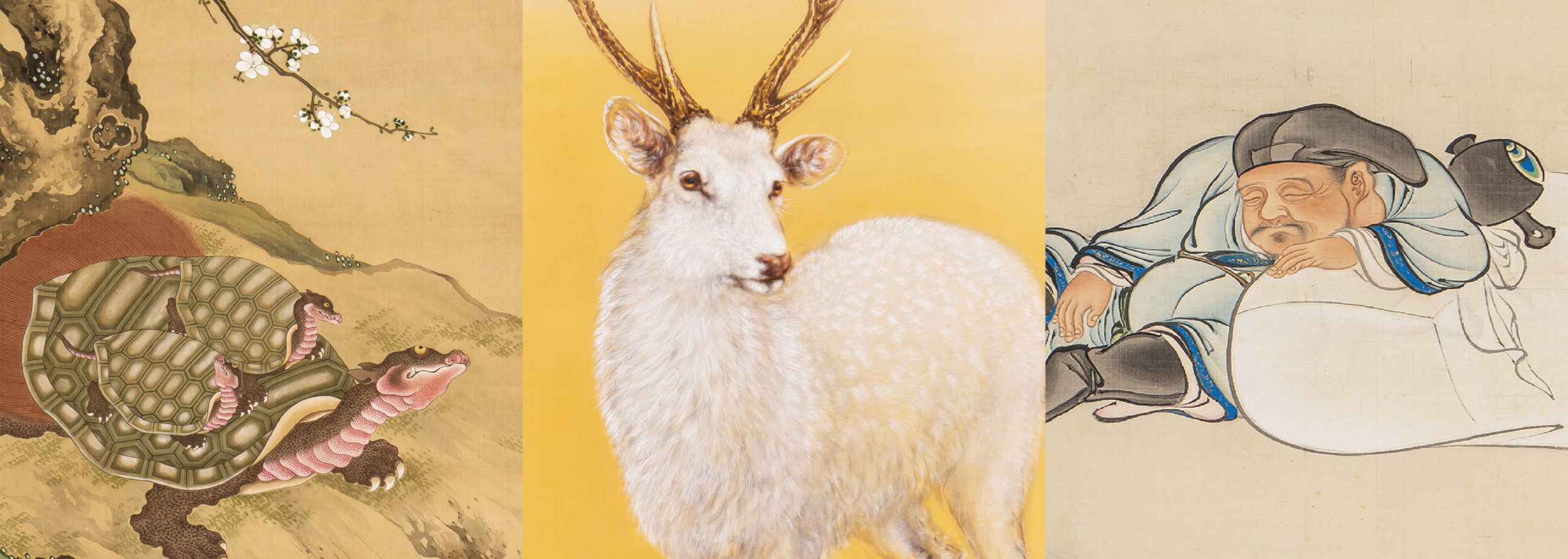
An auspicious object is something that invites prosperity, a long life, or other good fortune. In China, since ancient times, plants, animals, and other motifs associated with good fortune have been painted to attract luck. This culture spread to Japan. Many lucky motifs became established, such as the Seven Lucky Gods and Three Friends of Winter, that is, pine, bamboo, and plum. The auspicious New Year dream sequence—first, Mount Fuji; second, hawk; third eggplant—was also a popular subject for painting. Throughout the ages, expressing their heartfelt desire for happiness, Japanese people have displayed auspicious paintings in alcoves and in formal rooms. Various wishes can be inferred from the supposed inherent qualities of the depicted subjects. Pun-based associations may also express a hope: for example, the Japanese word for eggplant has the same sound as nasu, which means “to achieve”. In this section, you can discover surprising hidden meanings in images of familiar items whose auspicious symbolism may not be obvious.
Furthermore, many seasonal events throughout the year also carry wishes for children’s healthy growth and peaceful lives. At the end of this section, we present for the first time the Twelve-Month paste-up folding screen by Kaburaki Kiyokata (1878-1972). Better known for his masterful feminine beauty paintings, he here captured some waning customs in the modern era.
Section 3. The World of Higashiyama Kaii: A Prayer in every Brushstroke
In another turn, we present works by Higashiyama Kaii (1908–1999), a giant of Japanese painting whose every brush stroke was a prayer: he said, “Painting is the prayer of a heart that wishes to live sincerely.” Throughout his life, inspired by landscapes, he created works filled with a tranquil serenity that seems to purify the viewer’s heart.
Having been plunged into despair by horrific wartime ordeals and the successive loss of loved ones, his unique vision of landscape emerged after the war. While gazing on the sunset-colored mountains of Kanōzan in Chiba Prefecture, Kaii discovered profound peace and solace. This transformative experience led Kaii to perceive the landscape not merely as scenery, but as a mirror reflecting his inner self. Thereafter, he drew on his deepest feelings and into his paintings he poured heartfelt prayers for inner peace.
Attracting the eye with their luminous simplicity and spiritual depth, Kaii’s profound works evoke affection in their gaze. In this section, please let the prayerful tranquility of Kaii’s world touch your heart. As well as producing refined paintings, Kaii wrote limpid prose worthy of praise by literary Nobel laureate Kawabata Yasunari (1899−1972).

Exhibition Overview
| Title |
Let All be Well – Prayers in Paint – |
|---|---|
| List of Works | |
| Dates |
July 18 (Sat.) 2026 – September 6 (Sun.) 2026 |
| Opening Hours | 10:00 – 17:00 (last entry 16:30) |
| Closed |
August 18 (Tue.) |
| Venue |
Fukuda Art Museum: 3-16 Susukinobabachō Saga-Tenryuji, Ukyō-ku, Kyoto |
| Entry Fee |
General / University student: ¥1,500 (¥1,400) * Prices in parentheses are for groups of 20 or more.
<Combo Tickets with Saga Arashiyama Museum of Arts & Culture> *If you purchase an online ticket of the Fukuda Art Museum, you will get a discount for the entry fee of the Saga Arashiyama Museum of Arts & Culture. Therefore, you can enter both museums as the same price of the combo ticket. |
| Supported by | Kyoto Prefecture, Kyoto City, Kyoto City Board of Education |